Monday, September 10, 2012

Hunter Valley Wine Tour

Amy and Adam suggested that Tim and I take a mini-bus ride to Hunter Valley, one of Australia's big wine producing areas, a few hours north of Sydney.  Tim and I agreed that wine-tasting was a necessity whilst in Australia (did ya see what I did there?) as we are having a bit of wine withdrawal here in Indonesia (wine prices are exorbitantly high and if you splurge on a bottle, you're not guaranteed to get one that's been properly stored)...  Glad we did the tour, as Hunter Valley was quite lovely and it was nice to taste the wines without worrying about driving ourselves home.

On a tour with Boutique Tours Australia, we got to check out and taste wine from 3 small wine producers (all of which only sell wine from their cellar doors- not to bottle shops or restaurants).  Hunter Valley is known for its Semillion wine, but we drank a whole range of wines, including Shiraz, Chardonnay, Cabernet Sauvignon and Verdelho, among others. Pretty much everything we tasted was pretty tasty! 


Our first stop was Iron Gate Estate where we tried about 10 different wines... ranging from super dry and oak-y to really rich and fruity, to a sparkly wine.  Good stuff.


As you can see, Tim was into it, including trying to shove his nose all the way into the glass and occasionally doing the weird wine gurgle in an attempt to aerate the wine on the way down...


Since it was Australian winter, the vines were pretty bare, but the valley was quite pretty anyway:


They explained to us how they always hand pick their grapes, rather than using a machine picker, as the one time they tried the machine harvesting method (which sucks up not only grapes, but leaves, spiders and other flora and fauna), they ended up accidentally running a rather large blue-tongued lizard through their de-stemmer (below), which gummed up the works a bit. 


The scenery was really beautiful, particularly the hills at Mount View Estate, our second wine tasting stop:


In between wine tastings we stopped at a couple other gourmet food shops for some samples, including the aptly named Smelly Cheese Shop and a chocolate shop that housed this life-sized jelly bean kangaroo below, complete with joey.  The shop had been hit with a "ram raid" the night before... Tim and I had no idea what they was until we looked it up after the fact (it's when thieves drive a truck through the window of the shop and then raid it for money and stuff...), but seemed no worse for wear.


It's hard to see in this photo, but those dots underneath the trees are a mob of kangaroos, chilling and waiting for their chance at wine tasting.... not really though- our guide told us that the 'roos don't mess with the vines.


Our last stop was Ernest Hill Wines, where we had a pretty great host, Clint, who lead us through their tasty wines:


Friday, September 7, 2012

Kangaroo Valley: Three Views Hike

After getting our fill of kangaroos and wombats (well, I don't know if I got my "fill," but I checked them off my list of Australian stuff to see), we went on a "walkabout" (or maybe just a hike) in Kangaroo Valley.  We did the Three Views Trail to the Shoalhaven River view, which was quite lovely, passing through open woodland and sandstone heath vegetation.  Lots of sun, sand, eucalyptus and scruffy vegetation.  Not so much fauna- a couple of birds and one small snake, but a ton of cool wildflowers.


 Many of the wildflowers we saw seem to be endemic to Australia, which is pretty cool...  this pink one below I think may be a variety of boronia:


I think the yellow and brown guys below are brown pea flowers, which I thought looked like teeny tiny orchids: 


This periwinkle dude is called a "sun orchid," I believe:


Glad we wore hats, as much of the hike was unshaded on these scruffy plains, as you can see from the photos below.  As Adam told us, the rule for Australian kids is "no hat, no play" because the sun is so strong and the UV rays so potent due to the hole in the ozone layer covering southern Australia.  You definitely feel crispy after even a brief time out in the Aussie sun.


Not sure what these cones and little buds are below... anyone better at plant identification than me?  Anyone?  Anyone? Bueller?


I think these red guys are maybe Grevillea?:


The two photos below are, I think, scribbly gum eucalyptus.  Apparently the scribbles on the bark are caused by the larvae of the scribbly gum moth:


This light pink, 5-petaled flower is Eriostemon, I believe:


The view from the top was quite pretty.  You can see the Tallowa Dam and Lake Yarrunga as well as the Shoalhaven River:


On the other side, the view is of the Shoalhaven River gorge and Ettrema Wilderness Area:


Here, in these photos below, you can see Tim and I try and fail to take successful self-portraits using a number of different methods... I blame it on the blustery wind and treacherous rocks... it was so windy I was worried that the camera would blow off the clifftop:


It's hard to tell how windy it was, but you can see that all of the clifftop plants are windblown to the right:


These weird pine-coney looking this are the "fruit" of the Banksia tree, I believe, that have gone old and brown:


I think the pink flower below on the left may be the Mountain Devil, just blooming, and the pea pod looking things on the right I haven't figured out yet.


I think the bottle-brush shaped flower at the bottom is also a type of Banksia, and the white curly flowers layered between spikes are the hakea sericea/silky hakea/needle bush: 


Thursday, September 6, 2012

Kangaroo Valley: Wombats and Scenery

When at the Symbio Zoo, Tim and didn't actually see any wombats, but we did see this sign with these two fun facts on it: 
 
1. "Wombats have a specialized bony plate on their rump which they use as a defense mechanism; if a predator puts their head in their burrow, the wombat will use this to crush the predator's skull."

A head-crushing ass.  Awesome.

2. "Wombats can weigh up to 40 kg (88 lbs) and can run up to speeds of 80 km/h (50 m/h)"

I'll be honest- these guys do not look like they go anywhere fast.


  • They are marsupial and have a pouch like kangaroos, but they are backwards so that when the wombat digs its burrow, it doesn't cover its babies in dirt.
  •  Wombats have a slow metabolism and take 8-14 days to digest.
  • They have distinctive cubic feces. 
You're welcome.

On the way to Kangaroo Valley, we saw many signs like the one below, perhaps indicating that there is a problem with wombat roadkill... we did see at least one on the side of the road that looked like it had seen the business end of a ute (pronounced  "yoot" or "yoot-ee," short for utility vehicle, but really a modern Aussie version of the El Camino).


 Immediately upon arrival at the campground, we saw a couple wombats lumbering around, munching on grass.  They were definitely not particularly scared of us, but did wander away when we got too close:


As far as I can tell, they pretty much just eat grass and wander around:


The scenery at the campgrounds were pretty... that river looks like a good place to swim:


I liked the shape of these eucalyptus trees... plus we caught a glimpse of a wombat through them:


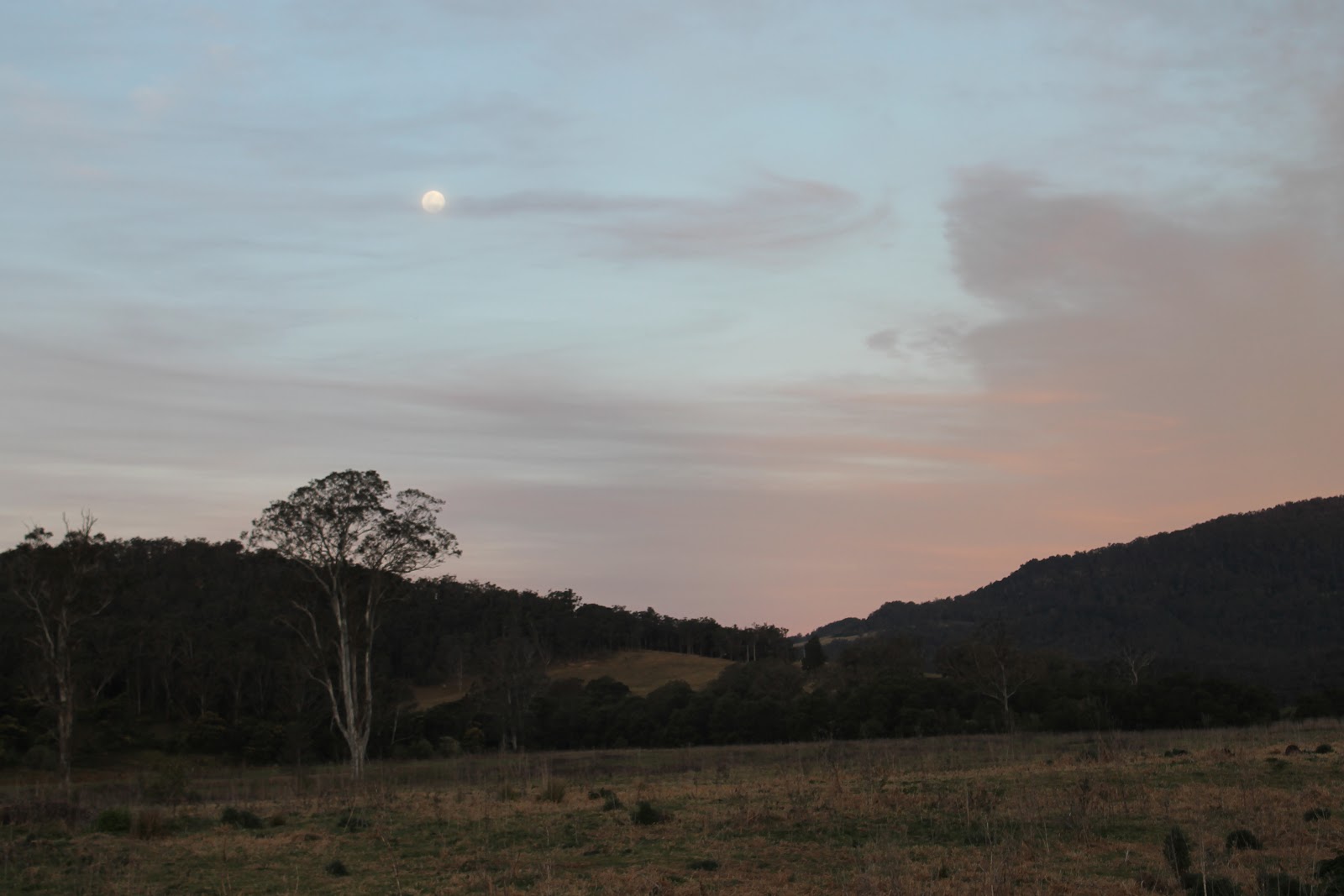
The moon rising over the kangaroo patch was pretty cool, too:


Wednesday, September 5, 2012

Kangaroo Valley: Kangaroos!

Tim and I rented a car towards the end of the week and drove 2 hours south to Kangaroo Valley to take in the scenery, stay at a cute B&B and hopefully see the animal for which the valley was named.  However, Amy suggested that we stop at the Symbio Wildlife Center on the way down in case we weren't able to find 'roos and other animals in the wild, just so we could say we saw some.  I'm not normally all that into zoos, but Tim and I did have a great experience in the kangaroo area at Symbio:


Not only were we able to get really close to the kangaroos (if we had bought food, we could have fed them, apparently), but we were able to see that one of the kangaroos had a joey in her pouch, and I was able to capture it feeding from the pouch as well as going in and out of the pouch... super cool.  

Did you know that kangaroos are permanently pregnant, but can time when the baby actually makes its way out of the womb?  In times of drought, the mom will hold onto the little dude and halt his growth (diapause) until food sources are more readily available, at which time she'll let him out and he will crawl up and get inside her pouch, where he'll nurse until he can leave the pouch (even then he's in and out of the pouch, nursing but also eating grass, until such time as his mom kicks him out permanently and closes up the pouch to him.):


This quick video shows how alien-like the joey looks as it wiggles around in the pouch.  Creepy!:


After we finished up at the zoo, we kept driving to Kangaroo Valley.  After a beautiful, albeit quite twisty drive (during which we saw an echidna, a spiny anteater, skitter off the side of the road, narrowly escaping a future as roadkill), we arrived and dropped our stuff at the Tall Trees B&B.  On the innkeeper's recommendation, we then headed to the Bendeela campground, where she assured us we would definitely see wombats (more on them in the next post) and hopefully see kangaroos since it was dusk and they would be pretty active.

Our first wild kangaroo siting was this random guy, creepily staring at us from the edge of the woods... look very hard and you'll see him (you may have to enlarge the photo).  He's quite far away.


After that, we saw more and more kangaroos bopping around in the distance, camouflaged quite well by the grass:

Then, to our delight, we caught 2 of the kangaroos boxing, doing judo-esque moves and occasionally kicking each other.  Based on some info we learned later in the trip, we believe it was probably 2 young males practicing their moves.  Juvenile males learn to box from their moms, but don't start practicing the judo/grabby business until later (and then practice with each other, not their moms), and they only kick once their tails have grown sufficiently strong such that they can lean back on it and kick both legs out.

It's hard to see in these photos, but there are two roos grappling with each other right at the top of the grass, just right of center:


I was able to get some video, though, that seems a little more clear.  Sorry for the wind noise in all of the following videos- it doesn't look like it, but it was super windy and really cold.  Also, please forgive the less-than-riveting commentary:


In this photo I got the kangaroos in the back, with a wombat wandering in the foreground:


Tim and I were standing and watching near a fence separating this grassy area from the picnic area where the grass was freshly mowed.  Slowly but surely the kangaroos above began to inch towards the fence, trying to make their way into the mowed area.  At the same time, kangaroos were coming out of the woods behind us and gathering at the mowed area... in total there were probably 60 or so kangaroos (the group is called a "mob"), we think all Eastern Greys.


Then the kangaroos behind the fence decided we were harmless (we had been standing there harmlessly for like a hour waiting patiently) and made their move.  Despite the fact that they could probably have jumped the fence, they chose to scoot underneath it in order to get over to the mowed area.  Later in the week we learned that kangaroos love to eat the tender new grass shoots that pop up after mowing, so it makes sense why they were so excited to get over to the mowed area:


Here's a photo of the rising moon over a bunch of kangaroos just waiting by the fence for us to get the hell out of the way so they could hop over to the grassy knoll... you could practically hear them tapping their toes at us:


And in these videos you can see how the area around us had turned into the kangaroo superhighway... one after the other they came under the fence and bounded towards the grass, some more wary of us than others:


(Bigger version of this video linked here.)